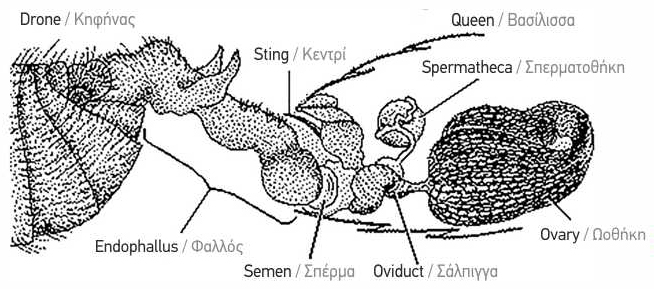
Three types of bees live in the colony: queen, drones and workers.
Female castes are determined by diet.
Sex is controlled by haplodiploidy but determined by the queen:
– Males are haploid (drones).
– Females are diploid (queens and workers).
Each bee plays a different role in the function of the colony.
2. Queen Honey Bees
One queen lays all the eggs in a hive. She may lay 500,000 eggs over her 2-3 year life span.
She produces ‘queen substance’ from her mandibular glands. This pheromone keeps workers from laying eggs and limits supersedure behavior.
Becoming a Queen:
Queens come from fertilized diploid eggs that are laid in special vertical cells called queen cups. These are “drawn out” and become queen cells.
A queen is fed royal jelly her entire larval life.
3. Drone Honey Bees
Their only job is to mate with virgin queens. They take orientation flights. They begin flying for 2-4 hours each afternoon at drone congregation areas. They have large eyes so they can see queens while flying.
Few mate successfully. In hive, drones are tended to by the workers. Drones contribute little to the function of the colony. They consume food and lounge around otherwise. They are kicked out of the hive by worker bees when winter arrives. Drones have bad “pr” with many beekeepers.
4. Worker Honey Bees
The roles of worker bees are the following:
Cleaner Bees
Nurse Bees
Honey Producers (Nectar ripening)
Guards
Read more about each role
5. Metamorphosis
Developmental Timeline:
1. Queen lays egg in wax cell
2. Worker feeds hatched larva
3. Larva reaches full growth
4. Worker seals cell
5. Larva becomes a pupa
6. Adult bee leaves cell
6. Swarms
Swarming is how honey bees reproduce on a colony level, usually when their hive begins to feel crowded.
First, several new queens are reared. While they are developing as larva, the old queen leaves with ~ 30-70% of the workers in the colony. The cluster of bees looks for a home into which to move.